

Robert Barnwell
Letter, Robert Barnwell to John Kean, April 19, 1789
Kean Galleries and Collections, Liberty Hall Collection
Audio Credits:
Reader: Doug Harris
Audio Director: Christopher Mallari, Audio Engineer, Kean University
New York April 19th, 1789
Dear Sir,
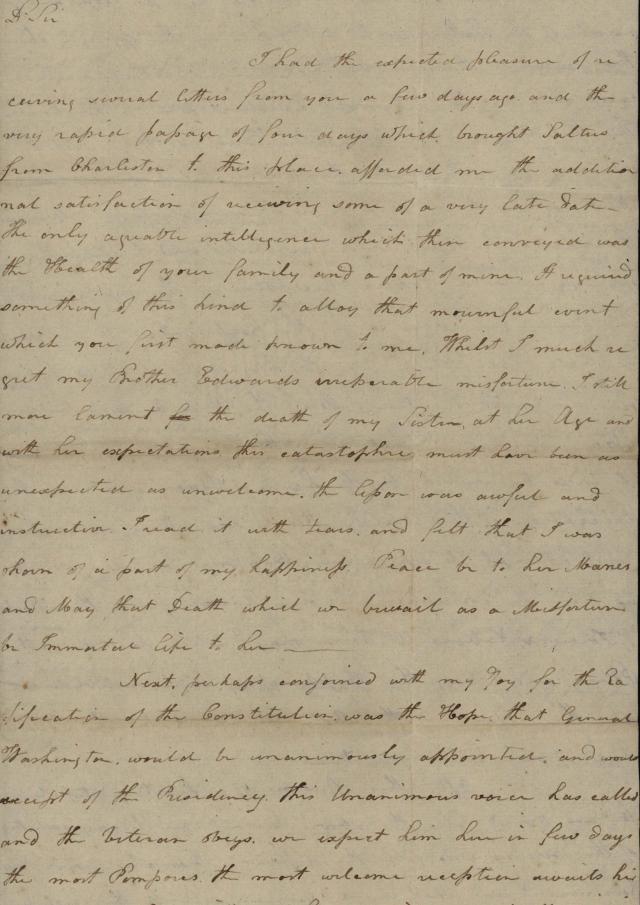
I had the expected pleasure of receiving several letters from you a few days ago and the very rapid passage of four days which brought Salters from Charleston to this place afforded me the additional satisfaction of receiving some of a very late date. The only agreeable intelligence which these conveyed was the health of your family and a part of mine. It required something of this kind to allay that mournful event which you first made known to me. Whilst I much regret my brother Edwards irreparable misfortune, I still more lament the death of my sister. At her age and with her expectations this catastrophe must have been as unexpected as unwelcome. The lesson was awful and instruction [sic]. I read it with tears and felt that it was shorn of a part of my happiness. Peace be to her manes [sic] and may that death which we bewail as a misfortune be immortal life to her.
Next, perhaps conjoined with my joy for the Ratification of the Constitution was the hope that General Washington would be unanimously appointed and would accept of the Presidency. This unanimous voice has called and the veteran obeys. We expect him here in few days. The most pompous, the most welcome reception awaits his arrival. A committee of Congress in a most magnificent barge (a present of the city) whose thirteen symbolical oars are to sweep her across the Hudson attended by a smaller one with the Recorder of the city and the Adjutant General of the state are to meet him on the opposite shore. The Governor, the Mayor, and their respective suites receive him in the city and conduct him to his house. The Milita receive him with feux de joie [formal military salute] and the whole City with smiles – the most grateful of receptions. New York is to be dressed in illuminations, and her Grand Parade is to blaze with fireworks and to close the scene a public reception in the most Grand and beautiful room up on the continent is to fix him in that office which like the key of the arch is to bind our Continent together. May the Ora be propitious. May Concord encircle us with his silken band. May its ends be united by the hands of peace and may the execration of the world attend him whose sword shall first attempt its separation. May our virtues protect us from the corruption and our union from the attacks of Foreign Nations. At home, may justice preside with policy and may the happiness of each individual and the welfare of the whole continent be the polar star of our government.
After this effusion of a heart grateful for an event like the above, permit me to say something of the persons who fill the different branches of our new government, and what in my opinion will be the first years’ transactions. A year which in government is in matrimony, I should suppose, would bring to our view our future prospects. The President first offers himself to my consideration surrounded with advantages which seems to stamp the approbation of Heaven upon our revolution of all consummations. This appointment was surely that the most devoutly to be wished for amidst the numerous applications for office, which will arise amidst the innumerable disappointments which must insure. Happy is it for us that we have a Hero, whose integrity and impartiality has been proved. Where but in him could we have found a man at whom determination importunity would be silent and glamour restrain her factious voice. A man from whom disappointment herself will return with a smile. This great advantage the character of our president, gives us almost as much reason to expect as to desire. In legislating, from whom could objections come with so much weight, by this Great Man.
A few words speak my opinion of our Senate, in my estimation they are as far as I am acquainted with them a good selection of the virtue and wisdom of this Continent – not equal perhaps to a Roman Senate or a Venetian Conclave – but desirous of promoting, and willing to effect, the political salvation of our country. Our Lower House is somewhat more heterogeneous. There are several very able men in this body, but it by no means equals my expectations. They have, it is true, a Maddisons and a Fitzsimmons, an Ames and a Waddsworth, and some others – men of talents but in general, however they may with men, they certainly have very few good speakers as for our state. How have the mighty fallen. Smith, it is true, is a good speaker and as far as I know a man of sense, but his particular situation has rendered him cautious of speaking. Tucker is a tolerably good thinker, but one of the worst speakers whoever harangued. Burke is Burkes still, a political Weathercock and Mr. Heuger is what everybody acknowledges him to be – a gentleman. You know Sumpter – he is not yet arrived. He has never been very high as my estimation. Are these, sir, to be taken as proper representation of a state where are the Rutledges, the Pinkneys, and many others whom I could mention, and you know. But they so are, and I am silent should our state suffer. Heavenly may the loss fall upon those who were able and declined to serve their country. To show you how much we require public speakers, read the enclosed report of a committee of the Lower House on the state of the nation. I fear the manufacturing mania, and the unaccommodating disposition of the Southern States must pay for their protection. Do me the favor of presenting my compliments to Mrs. Kean and my congratulations for her health. In addition to this, how happy should I be to hear that she is pleased with this residence of
Your honorable Servant
Robert Barnwell
In New York
April 19th 1789
John Kean Esquire
Beaufort
South Carolina
Disclaimer:
These transcriptions may be harmful or difficult to read. Materials presented here may reflect outdated, biased, offensive, or violent language and views.
These materials reflect the attitudes, perspectives, and beliefs of different times. Kean University does not endorse the views expressed in these collections, some of which contain images and language which may be offensive to some readers.