
Upcoming Events
Fall 2026
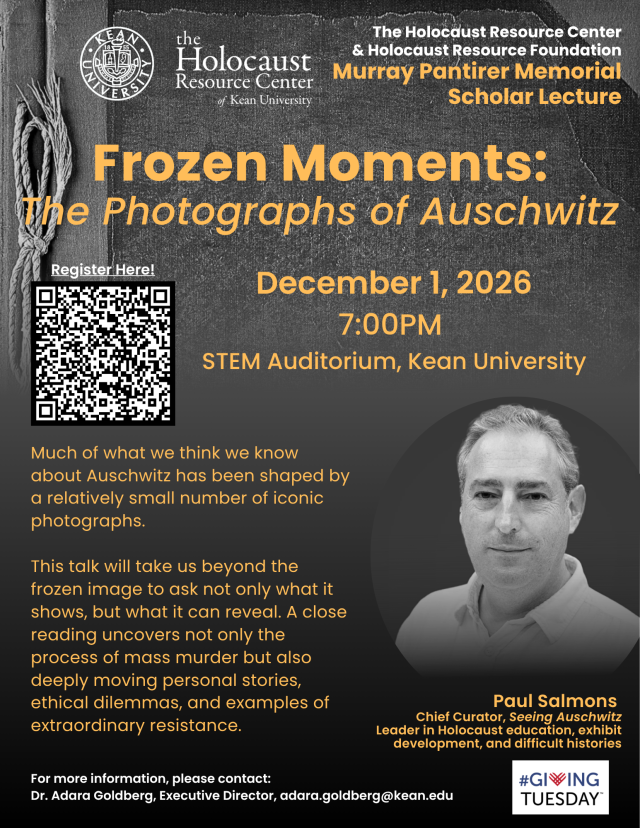
2026 Murray Pantirer Annual Scholars Lecture
Tuesday, December 1, 2026 at STEM Auditorium, Kean University
Much of what we think we know about Auschwitz has been shaped by a relatively small number of iconic photographs.
Paul Salmons, Chief Curator of Seeing Auschwitz, will take us beyond the frozen image to ask not only what it shows, but what it can reveal. A close reading uncovers not only the process of mass murder but also deeply moving personal stories, ethical dilemmas, and examples of extraordinary resistance.
For more information, please contact: adara.goldberg@kean.edu
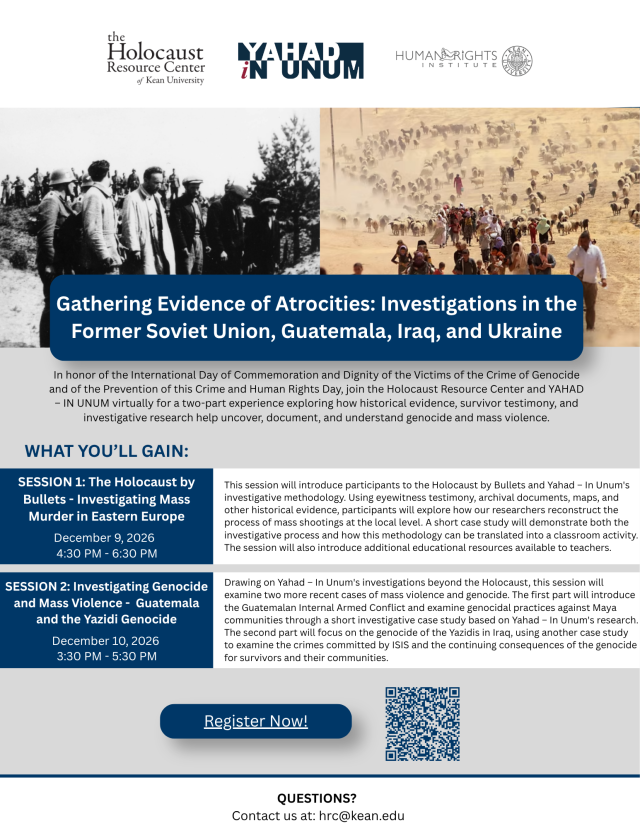
Gathering Evidence of Atrocities: Investigations in the Former Soviet Union, Guatemala, Iraq, and Ukraine
Wednesday, December 9, 2026 from 4:40pm to 6:30pm via Zoom
Thursday, December 10, 2026 from 3:30pm to 5:30pm via Zoom
In honor of the International Day of Commemoration and Dignity of the Victims of the Crime of Genocide and of the Prevention of this Crime and Human Rights Day, join the Holocaust Resource Center and YAHAD – IN UNUM virtually for a two-part experience exploring how historical evidence, survivor testimony, and investigative research help uncover, document, and understand genocide and mass violence. These are both VIRTUAL events.
For more information, please contact: hrc@kean.edu
Spring 2027
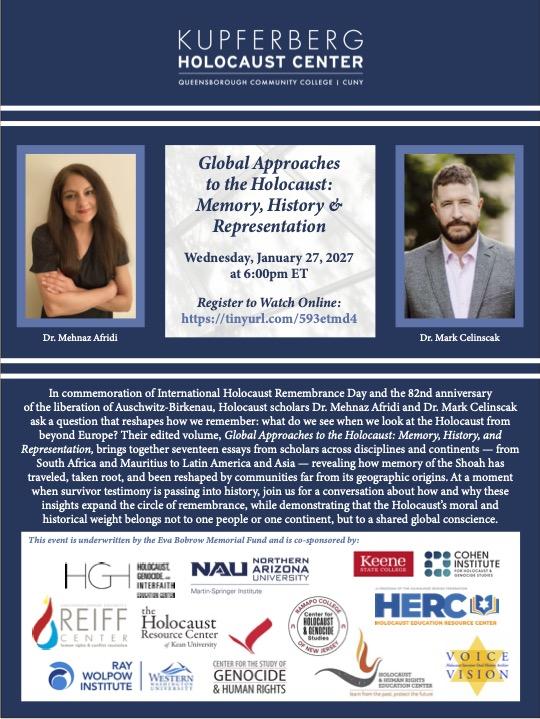
Global Approaches to the Holocaust: Memory, History & Representation
January 27, 2027, 6:00pm to 7:15pm ET
In commemoration of International Holocaust Remembrance Day and the 82nd anniversary of the liberation of Auschwitz-Birkenau, Holocaust scholars Dr. Mehnaz Afridi and Dr. Mark Celinscak ask a question that reshapes how we remember: what do we see when we look at the Holocaust from beyond Europe? Their edited volume, Global Approaches to the Holocaust: Memory, History, and Representation, brings together seventeen essays from scholars across disciplines and continents — from South Africa and Mauritius to Latin America and Asia — revealing how memory of the Shoah has traveled, taken root, and been reshaped by communities far from its geographic origins. At a moment when survivor testimony is passing into history, join us for a conversation about how and why these insights expand the circle of remembrance, while demonstrating that the Holocaust's moral and historical weight belongs not to one people or one continent, but to a shared global conscience. Co-sponsored by the Holocaust Resource Center of Kean University.
For more information, please contact: hrc@kean.edu
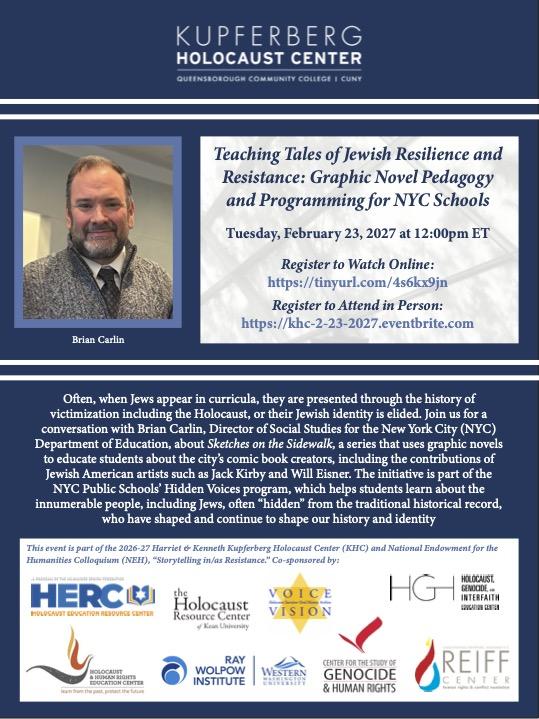
Teaching Tales of Jewish Resilience and Resistance: Graphic Novel Pedagogy and Programming for NYC Schools
February 23, 2027, 12:00pm to 2:00pm ET
Often, when Jews appear in curricula, they are presented through the history of victimization including the Holocaust, or their Jewish identity is elided. Join us for a conversation with Brian Carlin, Director of Social Studies for the New York City (NYC) Department of Education, about Sketches on the Sidewalk, a series that uses graphic novels to educate students about the city’s comic book creators, including the contributions of Jewish American artists such as Jack Kirby and Will Eisner. The initiative is part of the NYC Public Schools’ Hidden Voices program, which helps students learn about the innumerable people, including Jews, often “hidden” from the traditional historical record, who have shaped and continue to shape our history and identity. Co-sponsored by the Holocaust Resource Center of Kean University.
Register to Attend in Person!
Register to Attend Online!
For more information, please contact: hrc@kean.edu
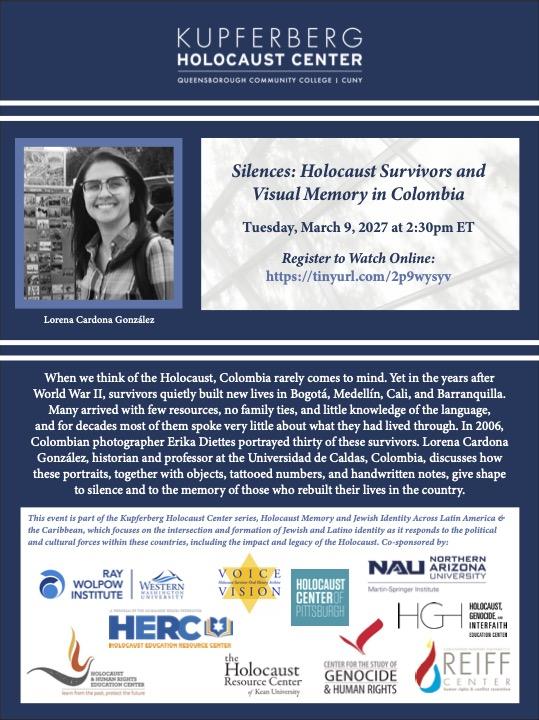
Silences: Holocaust Survivors and Visual Memory in Colombia
March 9, 2027, 2:30pm to 4:00pm ET
When we think of the Holocaust, Colombia rarely comes to mind. Yet in the years after World War II, survivors quietly built new lives in Bogotá, Medellín, Cali, and Barranquilla. Many arrived with few resources, no family ties, and little knowledge of the language, and for decades most of them spoke very little about what they had lived through. In 2006, Colombian photographer Erika Diettes portrayed thirty of these survivors. Lorena Cardona González, historian and professor at the Universidad de Caldas, Colombia, discusses how these portraits, together with objects, tattooed numbers, and handwritten notes, give shape to silence and to the memory of those who rebuilt their lives in the country. Co-sponsored by the Holocaust Resource Center of Kean University.
For more information, please contact: hrc@kean.edu
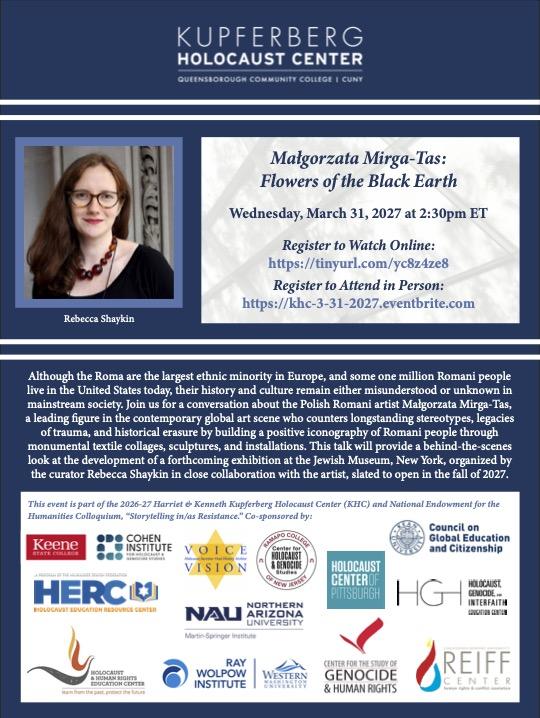
Małgorzata Mirga-Tas: Flowers of the Black Earth
March 31, 2027, 2:30pm to 4:00pm ET
Although the Roma are the largest ethnic minority in Europe, and some one million Romani people live in the United States today, their history and culture remain either misunderstood or unknown in mainstream society. Join us for a conversation about the Polish Romani artist Małgorzata Mirga-Tas, a leading figure in the contemporary global art scene who counters longstanding stereotypes, legacies of trauma, and historical erasure by building a positive iconography of Romani people through monumental textile collages, sculptures, and installations. This talk will provide a behind-the-scenes look at the development of a forthcoming exhibition at the Jewish Museum, New York, organized by the curator Rebecca Shaykin in close collaboration with the artist, slated to open in the fall of 2027. Co-sponsored by the Council on Global Education and Citizenship.
Register to Attend in Person!
Register to Attend Online!
For more information, please contact: hrc@kean.edu
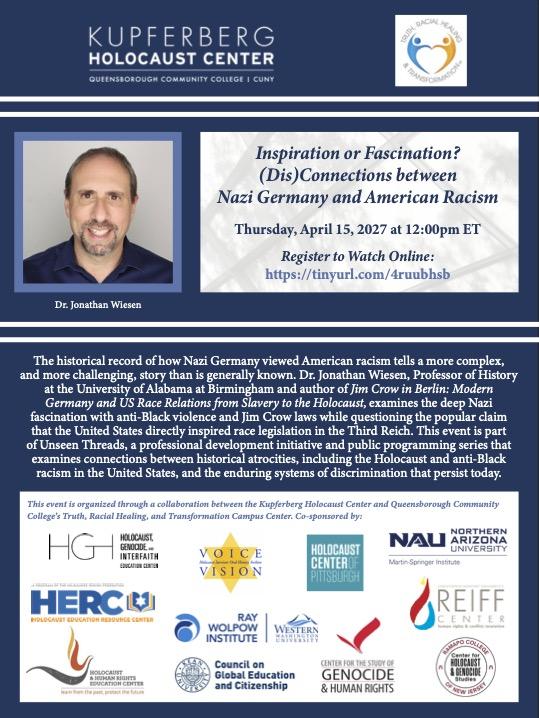
Inspiration or Fascination? (Dis)Connections between Nazi Germany and American Racism
April 15, 2027, 12:00pm to 1:00pm ET
The historical record of how Nazi Germany viewed American racism tells a more complex, and more challenging, story than is generally known. Dr. Jonathan Wiesen, Professor of History at the University of Alabama at Birmingham and author of Jim Crow in Berlin: Modern Germany and US Race Relations from Slavery to the Holocaust, examines the deep Nazi fascination with anti-Black violence and Jim Crow laws while questioning the popular claim that the United States directly inspired race legislation in the Third Reich. This event is part of Unseen Threads, a professional development initiative and public programming series that examines connections between historical atrocities, including the Holocaust and anti-Black racism in the United States, and the enduring systems of discrimination that persist today. Co-sponsored by the Council on Global Education and Citizenship.
For more information, please contact: hrc@kean.edu